High-precision evidence engine for competitive debate.
Search for evidence, mine entire sources, and break down opposing arguments. Powered by Tagma-1, our flagship model for cutting debate evidence.
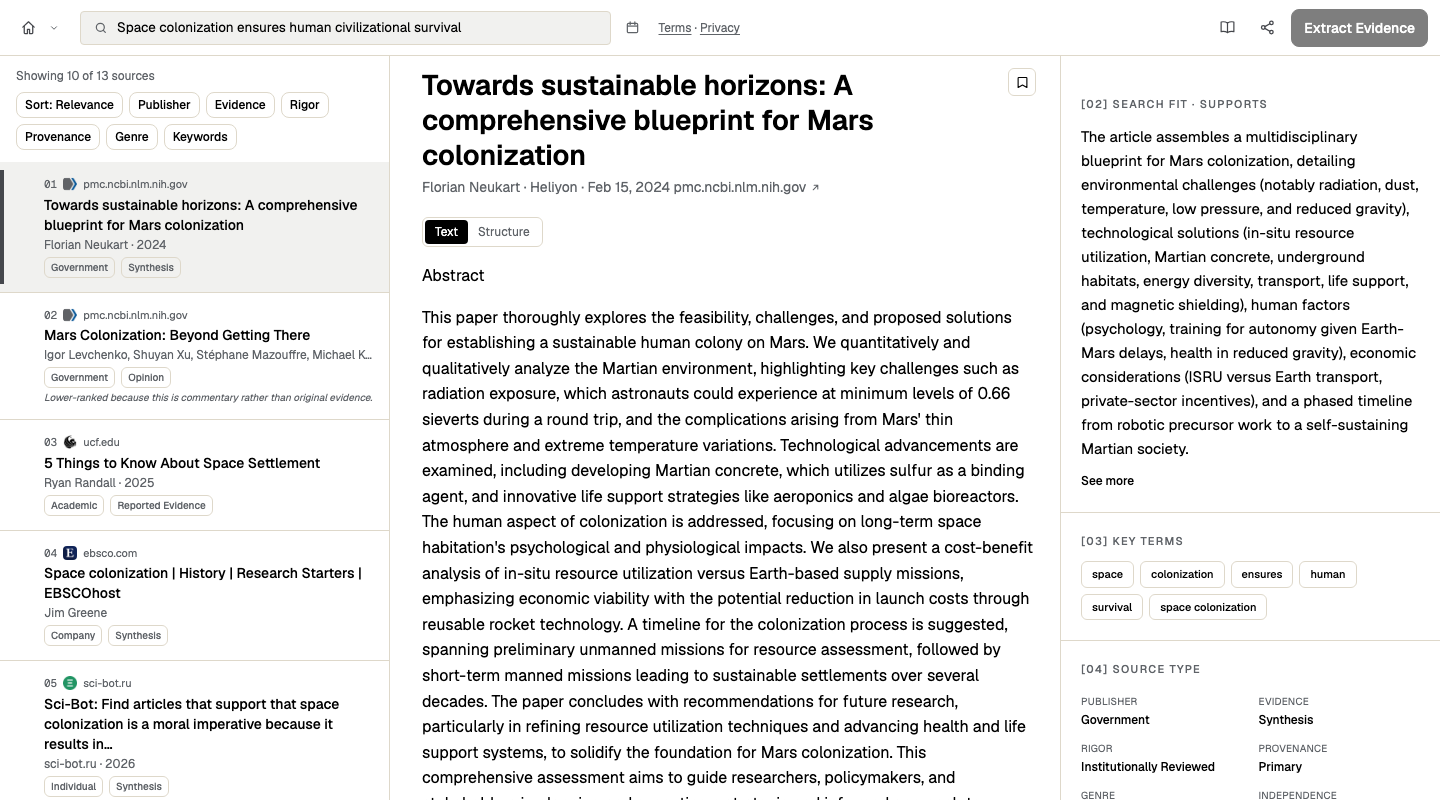
[01] Search
A search engine built for debate.
Hand Search a claim and it finds the strongest sources on the open web. Browse the ranked results like you would any search engine, tuned to your claim.

01
A search engine that researches for you.
Traditional search engines return a pile of blue links and leave the research to you. We extract and read every source in full, score it against your exact claim, and surface the strongest results first.
02
Native citations and author qualifications.
Citation extraction is hard. It requires turning messy, unstructured data into clean, structured cites. Our system does it reliably and matches the best dedicated extractors, with a 95% success rate in internal testing.
03
Over-engineered to never miss a source.
Built to handle the toughest sites: IP bans, geoblocks, anti-bot systems, proxies, lazy-loading, popups, clickthroughs, and endless scroll. We recover nearly any URL on the open web, so scraper limits are never a reason to miss a source.
04
High-precision URL extraction.
Every URL selected for cutting is refetched by an ensemble of 5 extractors at once. Their results are compared and resolved into a single version we stand behind, reducing the risk of bad text making it into a card.
[02] Mine
Argument mining at your fingertips.
Point Mine at a PDF or a URL and it finds every extractable argument on its own, with no claim steering which spans matter. Mine reads the source the way a debater would, noticing where reasoning shifts and where one argument ends and another begins.

01
Built to cut books in minutes.
Point Mine at a 300-page book and it comes back with an entire file in minutes. Feed it a large batch of URLs instead and it runs the same way.
02
Tuned for K debate.
Mine works on any type of content, but dense K literature, the kind that punishes a skim, is what it's built for.
03
Assisted reading built in.
Mine returns PDFs in a built-in viewer with a highlight overlay, suggested cards in the margin, and a breakdown of each argument's warrants. Reading turns into a guided pass instead of a hunt.
04
High-precision PDF extraction.
Mine runs on state-of-the-art PDF extraction, pulling text with word-for-word confidence on every token. Built to handle the toughest cases, including messy, scanned documents.
[03] Counter
Stay ahead of the competition.
Counter reads an opponent’s case file, maps its structure into individual arguments, drafts and curates candidate responses, then runs each one through the same Search pipeline for cited evidence before assembling the strongest results into a notebook.

01
Spin up a swarm of 50 searches at once.
Each candidate response becomes its own Search claim, with each claim surfacing an average of 50 curated results. That gives a single Counter run up to 2,500 URLs to research before returning a response file.
02
Curate what actually matters.
With thousands of URLs and potentially multiple usable cards from each, finding evidence is only half the job. Counter evaluates the resulting cards for relevance, citation quality, and usable span text, cutting the noise before the strongest evidence makes it into your response notebook.
[04] Core engine
Tagma-1 cuts cards the way your team does.
Every card from Search, Mine, and Counter goes through Tagma-1. In one pass over the source it writes the tag, picks the words you read aloud, and marks the warrant that makes the argument work.
Most AI tools write evidence for you. Tagma-1 isn’t allowed to. It can only point at words already on the page, and every highlight is checked against the original source before you see it.

01
It can't put words in an author's mouth.
Every highlighted word is matched back to the original source before a card is returned. If a fragment was reworded, even slightly, it either lands on the author's real wording or it gets dropped.
02
It cuts in your team's style.
Upload a docx of cards you have already cut. Tagma-1 learns how much you read, how short your fragments run, and how your tags sound, and uses that style on every pipeline.
03
Base or tight, per run.
Base cuts a complete card that is no longer than it needs to be. Tight trims to the fewest words that still carry the argument, for when speed matters more than polish.
04
Measured against real debaters.
We benchmark Tagma-1 against thousands of cards cut by competitors across seven divisions, and grade changes blind against a fixed test set instead of eyeballing a few examples.
[05] Notebooks
A case editor that knows what a card is.
Notebooks replaces Word and Verbatim. Cards drop in from any pipeline with their tag, cite, and highlighting intact, right next to your pockets, hats, blocks, and analytics. Present mode strips a file down to what you actually read aloud. Free on every plan.

[06] Workspaces
A shared drive, graphed by argument.
Your team’s files in one place, like Dropbox, except Tagma reads everything you put in it. Every file is broken down into cards, authors, and citations, so you find evidence by what it says, not by what someone named the file. Included on every plan.

[07] MCP
Bring Tagma into your AI assistant.
Connect Tagma to Claude or any other MCP-compatible assistant and ask for evidence in plain language. Your assistant runs the same Search, Mine, and Counter as the app, gets back the same cut cards, and can save them straight to your workspace.

[08] Start
Start a notebook.
Free to start. No credit card.